
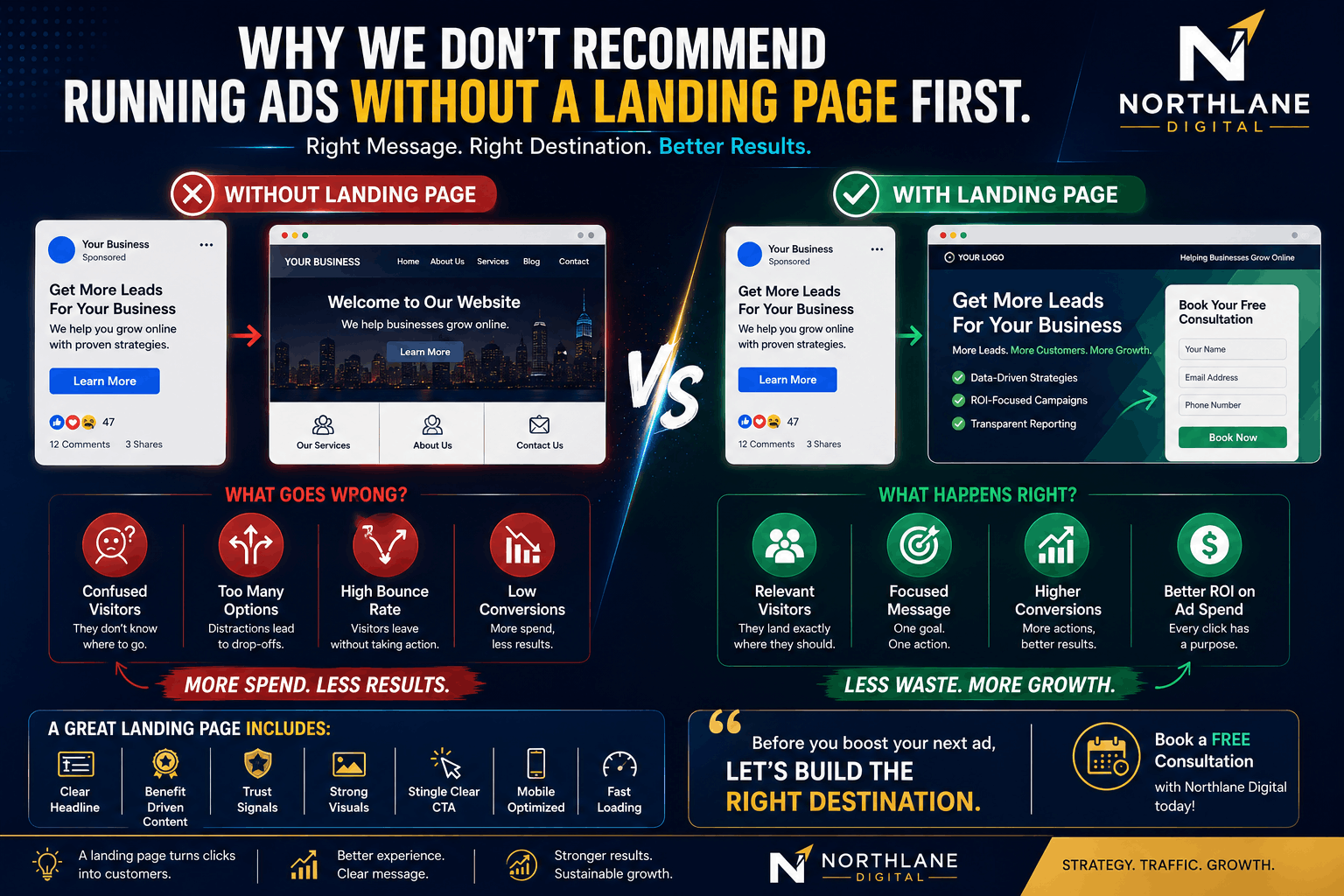


Running ads without a landing page can look like the fastest way to get started. You create an ad, choose your audience, set a budget, and send people to your website. However, this approach can create problems before your campaign gets a fair chance to perform.
At Northlane Digital, we believe your ad should lead people somewhere designed for the next step. A landing page gives your campaign a focused destination. It also helps you measure what happens after someone clicks.
If you are preparing your first Google Ads or Meta Ads campaign, this matters because every click costs money. Therefore, you should make each click as useful as possible.
What Happens When You Skip a Landing Page?
Without a dedicated landing page, businesses often send ad traffic to their homepage. A homepage usually serves many purposes. It may introduce the company, display several services, show blog posts, and provide multiple contact options.
However, an ad usually has one specific goal.
You may advertise a consultation, a product, a service, or a special offer. When the visitor reaches a general homepage, that focused message can disappear.
As a result, the visitor has to figure out what to do next. Some people will continue exploring. Others will simply leave.
That does not automatically mean every campaign needs a separate landing page. However, when your campaign has a specific conversion goal, a dedicated landing page often gives you more control.
Running Ads Without a Landing Page Can Waste Ad Spend
Every advertising campaign needs a budget. Therefore, you should think beyond the cost of creating the ad.
Imagine paying for 100 clicks. Those clicks only create value if the visitors find what they expected and take the next step.
When you send those visitors to a general homepage, they may have to search for the offer. They might click through several pages before finding your contact form.
That creates unnecessary friction.
A dedicated landing page removes many of those distractions. It keeps the visitor focused on the offer that brought them there.
For example, you might run a Google Ad for a free business consultation. Instead of sending visitors to your homepage, you can send them to a page explaining the consultation.
The page can then answer the questions that matter:
- What is the consultation?
- Who is it for?
- What will the visitor receive?
- Why should they book?
- How can they book?
Therefore, your advertising budget supports a clearer customer journey.
Running Ads Without a Landing Page Makes Conversion Tracking Harder
A click is not the same as a conversion.
Someone clicking your ad tells you that the ad attracted attention. However, you also need to understand what happened afterward.
Did the visitor submit a form?
Did they book a consultation?
Did they call your business?
Did they purchase something?
A dedicated landing page can make these actions easier to define and track.
For example, you can create one page specifically for a Google Ads campaign. You can then connect the form submission or booking action to your conversion tracking setup.
As a result, you gain a clearer view of campaign performance.
You can learn which campaigns generate meaningful actions instead of judging performance only by clicks.
For more background on landing page performance and conversion research, see [EXTERNAL LINK: HubSpot landing page conversion research].
A Landing Page Creates a Better First Impression
Your advertisement creates a promise.
The landing page needs to continue that promise.
If your ad looks modern and professional but sends visitors to an outdated page, the experience feels inconsistent.
As a result, the visitor may question the credibility of the business.
A dedicated landing page lets you control that first interaction. You can match the page’s message, visuals, offer, and tone with the advertisement.
You can also remove unnecessary navigation and distractions.
This matters because people make quick decisions online. Therefore, your page needs to communicate its value quickly.
A good landing page does not need to be complicated. Instead, it needs to be relevant, clear, trustworthy, and easy to use.
Your Landing Page Should Have One Clear Call-to-Action
One of the biggest problems with sending ad traffic to a homepage is choice overload.
Your homepage might say:
Learn More
Contact Us
Our Services
Read Our Blog
Follow Us
View Portfolio
Those options may make sense for a homepage. However, they can distract someone who clicked an ad for one specific reason.
A landing page gives you an opportunity to focus on one primary action.
For example:
Book Your Free Growth Consultation
Then explain the value and provide the booking form.
Or:
Request Your Free Website Audit
Then guide the visitor toward submitting the request.
The goal is not to force every visitor into the same action. Instead, you should make the intended next step obvious.
Your Ad and Landing Page Should Tell the Same Story
This is one of the most important reasons to use a dedicated landing page.
Imagine seeing an advertisement that says:
Get a Free Website Performance Audit
You click it.
However, the destination page says:
Welcome to Our Digital Marketing Agency
Now you have to search for the audit.
That disconnect creates friction.
Instead, the landing page should continue the same message:
Ad:
Free Website Performance Audit
Landing Page:
Get Your Free Website Performance Audit
CTA:
Request My Audit
This creates a consistent journey from the first impression to the conversion.
Therefore, your ad and landing page should work as one system.
What a Good Landing Page Includes
Your landing page does not need dozens of sections. Instead, focus on the information your visitor needs to make a decision.
A strong campaign landing page can include:
- A clear headline
- A short explanation of the offer
- Benefits for the visitor
- Relevant trust signals
- Supporting visuals
- A clear call-to-action
- A simple form or booking option
- Answers to common objections
- Mobile-friendly design
- Conversion tracking
Most importantly, every section should support the primary goal.
If a section does not help the visitor understand, trust, or act, consider removing it.
What We Do Instead at Northlane Digital
At Northlane Digital, we don’t start with the question, “What ad should we run?”
We start with the customer journey.
First, we understand your business and campaign objective. Then, we identify the audience and offer.
After that, we look at the destination experience.
If your campaign needs a focused conversion path, we can recommend a dedicated landing page before launching the ads.
We then connect the campaign, landing page, tracking, and conversion goal.
You can explore our [INTERNAL LINK: Growth Package page] to see how we approach digital growth as a complete system rather than treating each service separately.
This approach helps you understand what your advertising is actually trying to accomplish.
Don’t Pay for Traffic Before Preparing the Destination
Running ads can bring people to your business. However, getting someone to click is only the beginning.
Your landing page needs to continue the conversation.
Therefore, before you launch your next Google Ads or Meta Ads campaign, ask yourself:
Where am I sending the visitor?
If the answer is simply “our homepage,” take another look at your campaign.
A dedicated landing page may give your visitors a clearer path and give you better control over the conversion journey.
At Northlane Digital, we can review your campaign idea, website, and conversion path before you spend your advertising budget.
Planning to launch your next campaign? Book a free consultation with us, and let’s look at the strategy before you spend the money.
Leave a Reply