
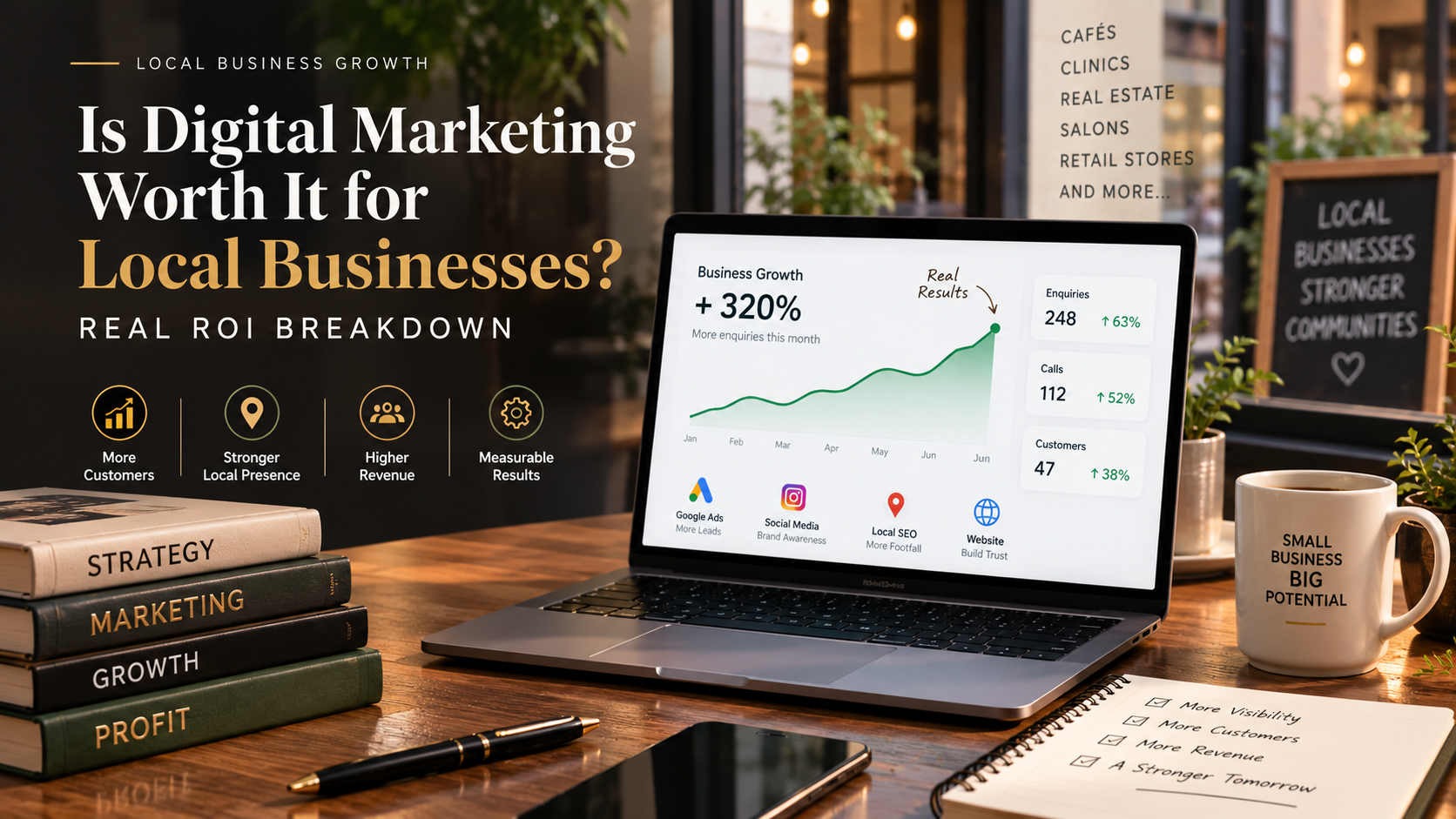

Is Digital Marketing Worth It for Local Businesses? Real ROI Breakdown
You may have heard this before:
“I already get customers through referrals. Why should I spend money on digital marketing?”
It’s a fair question.
For a local business, spending ₹10,000, ₹25,000, or ₹50,000 on marketing every month only makes sense if that spending can contribute to measurable business results.
The good news is that digital marketing can be measured much more precisely than many traditional marketing channels. Google Ads, for example, allows businesses to track valuable actions such as purchases, form submissions, and phone calls and use that data to evaluate ROI.
But digital marketing isn’t automatically profitable.
The real question is:
Can the customers generated through digital marketing be worth more than the cost of acquiring them?
Let’s break it down.
1. Is Digital Marketing Actually Worth It?
For many local businesses, digital marketing can be worthwhile because customers increasingly use search engines, Maps, websites, social media, and messaging platforms before making purchasing decisions.
But simply “being online” isn’t enough.
A business can spend ₹20,000 on ads and generate almost nothing if:
- The targeting is wrong
- The offer is weak
- The website doesn’t convert
- Leads aren’t followed up
- Conversion tracking isn’t installed
- The business targets the wrong customers
- The campaign is stopped before enough data is collected
On the other hand, a smaller campaign can be profitable when the economics work.
For example:
Marketing spend: ₹20,000
New customers: 10
Average profit per customer: ₹4,000
Estimated profit generated:
10 × ₹4,000 = ₹40,000
The marketing generated ₹40,000 in gross profit against ₹20,000 in marketing spend.
That’s a much more useful question than simply asking how many clicks or impressions you received.
2. What Does Digital Marketing ROI Actually Mean?
ROI stands for Return on Investment.
A simple formula is:
ROI = (Profit generated − Marketing cost) ÷ Marketing cost × 100
For example:
Marketing cost = ₹20,000
Profit attributable to marketing = ₹50,000
ROI:
(₹50,000 − ₹20,000) ÷ ₹20,000 × 100 = 150%
That means the business generated ₹1.50 in profit for every ₹1 invested, based on this simplified calculation.
Google also emphasizes that ROI should be evaluated against the business’s actual goals and that conversion tracking is necessary to understand which campaigns and keywords are producing valuable actions.
Don’t confuse ROI with ROAS
These are related but different.
ROAS = Revenue ÷ Advertising Cost
ROI = Profit relative to the investment
For example:
₹60,000 revenue ÷ ₹20,000 ad spend = 3× ROAS
But if your product costs ₹35,000 to fulfill, your actual profit is much lower.
That’s why local businesses should ultimately care about profit and customer value, not just impressive-looking advertising dashboards.
3. How Much Should a Local Business Spend?
There isn’t one correct digital marketing budget for every business.
A better approach is to start with the economics of the business.
Consider a local service business with:
- Average customer value: ₹10,000
- Gross profit per customer: ₹5,000
- Target customer acquisition cost: ₹1,500–₹2,000
A ₹20,000 monthly marketing budget could make sense if the business can consistently acquire enough profitable customers.
But a business selling a ₹500 product with ₹100 profit per order has a completely different calculation.
A simple starting framework
| Monthly budget | Possible focus |
|---|---|
| ₹5,000–₹10,000 | Local SEO, content, testing |
| ₹10,000–₹25,000 | SEO + paid search/social testing |
| ₹25,000–₹50,000 | Multiple channels + conversion optimization |
| ₹50,000+ | Scaling proven campaigns and channels |
These aren’t guaranteed spending requirements or guaranteed results. They’re simply useful planning ranges.
The right budget depends on your market, competition, customer value, conversion rate, and capacity to handle new business.
4. When Do You Get Your Money Back?
This is where payback period becomes useful.
Suppose a clinic spends:
₹30,000/month on marketing
and generates:
15 new patients
If the average contribution margin from each new patient is ₹3,000:
15 × ₹3,000 = ₹45,000
The campaign has generated ₹45,000 in contribution margin against ₹30,000 of marketing spend in this simplified example.
But there is another important factor:
Customer lifetime value
A customer may not purchase only once.
Imagine a dental clinic acquires a patient for ₹1,500 but that patient eventually generates ₹12,000 in revenue across multiple appointments.
The original acquisition cost may look expensive when viewed against the first appointment alone but much more attractive when evaluated against the customer’s longer-term value.
That’s why local businesses shouldn’t judge marketing only on the first transaction.
5. Case Study Example: Property Dealer
This is an illustrative scenario, not a Northlane Digital client case study.
Imagine a property dealer operating in a competitive city.
Before implementing a structured digital strategy:
- Website: basic or outdated
- Google visibility: limited
- Leads: inconsistent
- Paid advertising: little tracking
- Follow-up: manual
Suppose the business generates only 2 qualified enquiries per month from online channels.
Now imagine the business invests:
₹25,000/month
across targeted search advertising, landing page optimization, local SEO, and conversion tracking.
After optimization, assume the campaign generates:
25 qualified leads
If the sales team converts 20% of those leads:
25 × 20% = 5 customers
Now suppose the average contribution from each customer is ₹30,000.
5 × ₹30,000 = ₹1,50,000
Marketing investment:
₹25,000
This creates a potentially attractive acquisition model.
But notice something important:
The marketing campaign didn’t magically create ₹1.5 lakh.
The result depends on:
- Lead quality
- Sales process
- Property inventory
- Pricing
- Follow-up speed
- Conversion rate
- Market demand
Marketing is only one part of the system.
6. Case Study Example: Dental Clinic
Again, this is an illustrative scenario.
Imagine a dental clinic that already has patients but depends heavily on referrals.
The clinic wants more predictable new-patient acquisition.
Suppose it spends:
₹20,000/month
on local search visibility and Google Ads.
The campaign produces:
40 enquiries
If 25% become paying patients:
40 × 25% = 10 new patients
Suppose the average initial contribution from each patient is ₹4,000:
10 × ₹4,000 = ₹40,000
At first glance:
₹40,000 contribution − ₹20,000 marketing = ₹20,000
But the real opportunity could be larger if some patients return for additional treatments.
This is why healthcare businesses should consider both initial patient value and potential lifetime value.
7. Case Study Example: Small E-commerce Brand
Illustrative scenario — not a claimed client result.
Imagine a small e-commerce business generating:
₹5 lakh/month
in revenue.
The business improves:
- Product pages
- Google Ads
- Meta Ads
- Retargeting
- Email marketing
- Conversion rate optimization
Suppose revenue eventually reaches:
₹20 lakh/month
That sounds impressive.
But revenue alone doesn’t prove that digital marketing was profitable.
You would also need to examine:
- Ad spend
- Product costs
- Shipping
- Returns
- Discounts
- Agency fees
- Payment fees
- Customer acquisition cost
- Repeat purchases
For example, ₹20 lakh revenue with very low margins may be less attractive than ₹12 lakh revenue with healthy margins.
Revenue is not profit.
That’s one of the most important lessons when evaluating digital marketing ROI.
8. Digital Marketing vs Traditional Advertising
Traditional advertising isn’t necessarily bad.
Hoardings, newspapers, flyers, events, radio, and print advertising can still make sense for certain businesses.
The major difference is often measurement.
With a traditional billboard, you may estimate how many people could have seen it.
With digital marketing, you can often track a much clearer path:
Ad → Click → Website → Lead → Call → Customer → Revenue
Google Ads conversion tracking can measure actions such as purchases, sign-ups, and phone calls, helping businesses connect advertising activity with valuable customer actions.
That doesn’t mean digital marketing is automatically better.
It means it can provide more measurable feedback, allowing businesses to adjust campaigns based on performance.
9. What About Local SEO?
Digital marketing isn’t just paid advertising.
For a local business, local SEO can be extremely important.
A verified Google Business Profile helps eligible businesses appear on Google Search and Maps, where customers can see information such as location, hours, website, photos, and reviews.
For example:
“dentist near me”
“property dealer in Gurgaon”
“best bakery near me”
“AC repair in Delhi”
These searches can have strong local intent.
A local business can build visibility through:
- Google Business Profile
- Local SEO
- Website optimization
- Customer reviews
- Helpful content
- Location pages
- Relevant backlinks
- Search advertising
This creates a stronger long-term digital presence than simply running ads.
10. Mistakes That Waste Digital Marketing Budget
Mistake 1: Running ads before fixing the website
If your landing page doesn’t convince visitors, sending more traffic won’t solve the problem.
Mistake 2: Measuring clicks instead of customers
10,000 clicks don’t matter if they produce zero profitable customers.
Mistake 3: Targeting everyone
A local business should define its ideal customer, location, problem, and offer.
Mistake 4: Ignoring conversion tracking
Without tracking, you’re guessing.
Mistake 5: Stopping campaigns too quickly
Some campaigns need time and enough data to identify what works.
Mistake 6: Following vanity metrics
Followers, impressions, and likes can be useful indicators, but they aren’t the same as revenue.
Mistake 7: Ignoring follow-up
A marketing campaign can generate excellent leads, but poor sales follow-up can still result in disappointing revenue.
11. What Does REAL Digital Marketing Success Look Like?
Success isn’t necessarily:
“We got 100,000 impressions!”
For a local business, success could look like:
- More qualified enquiries
- Lower cost per lead
- More phone calls
- More booked appointments
- More store visits
- Higher conversion rates
- More repeat customers
- Better customer lifetime value
- Predictable acquisition
- Higher profit
The exact KPI depends on the business.
A dental clinic shouldn’t measure success exactly like an e-commerce brand.
A property dealer shouldn’t measure success exactly like a restaurant.
Your marketing metrics should follow your business model.
12. How to Start Without Taking a Huge Risk
You don’t need to immediately spend ₹1 lakh every month.
Start with a controlled experiment.
Step 1: Define one business goal
For example:
“Generate 20 qualified enquiries per month.”
Step 2: Calculate your economics
Know:
- Average customer value
- Profit per customer
- Maximum acceptable acquisition cost
- Current conversion rate
Step 3: Fix the conversion path
Make sure your website or landing page clearly communicates:
Problem → Solution → Proof → Offer → CTA
Step 4: Track everything important
Set up conversion tracking for:
- Forms
- Calls
- Purchases
- Bookings
- WhatsApp enquiries where measurable
- Other meaningful actions
Step 5: Start small
Test one or two channels instead of spreading a small budget across everything.
Step 6: Scale what works
Once you know which campaigns, keywords, audiences, and offers generate profitable customers, you can increase investment more confidently.
So, Is Digital Marketing Worth It for Local Businesses?
It can be — but only when the numbers make sense.
Digital marketing isn’t a magic button that turns ₹10,000 into ₹1 lakh.
It’s a system.
You invest money to generate attention and opportunities, then your website, offer, sales process, and customer experience determine how many of those opportunities become revenue.
The best question isn’t:
“How much does digital marketing cost?”
Ask:
“How much does it cost me to acquire a customer, and how much profit does that customer generate?”
Once you know those two numbers, marketing becomes much easier to evaluate.
Build a Marketing Strategy Around ROI
At Northlane Digital, we believe digital marketing should be connected to business outcomes—not just clicks, followers, or impressions.
From WordPress websites and SEO to Google Ads, Meta Ads, landing pages, and analytics, the goal should be to create a measurable path from visibility → enquiry → customer → revenue.
If you’re a local business owner wondering whether digital marketing is worth the investment, start with the numbers.
Understand your customer value. Set an acquisition target. Track your conversions. Start with a controlled budget. Then scale what actually works.
Frequently Asked Questions
How much should a local business spend on digital marketing?
There is no universal amount. Your budget should depend on customer value, profit margins, competition, conversion rates, and your growth target. Start with a budget you can measure and optimize rather than choosing a number simply because another business spends it.
How long does digital marketing take to show results?
Paid campaigns can generate measurable activity relatively quickly, while SEO and content usually require more time to build organic visibility. The timeline depends heavily on the industry, competition, website, budget, and execution.
What is a good ROI for digital marketing?
There is no universal “good ROI.” A profitable campaign depends on your margins, customer lifetime value, acquisition cost, and business model. A campaign generating 3× revenue may still be unprofitable if margins are low.
Should local businesses use Google Ads or SEO?
They serve different purposes. Google Ads can provide immediate opportunities to appear for relevant searches, while SEO can build organic visibility over time. Many businesses can benefit from using both strategically.
How do I know if my marketing is working?
Track meaningful business outcomes such as qualified leads, calls, bookings, purchases, customer acquisition cost, revenue, and profit—not just impressions and clicks.
Leave a Reply